
Why The Length Of Supermarket Paternity Leave Matters To Everyone
The UK supermarket sector has become increasingly competitive on family benefits. Enhanced maternity pay is now widely recognised as a talent and retention lever rather than a “nice to have”. The sector employs over 1 million people so every improvement has the power to make thousands of families better off every year.
But beneath the headlines, a familiar and damaging pattern is re-emerging: maternity leave surges ahead, while paternity leave is often left behind and with it, the same gender norms, career penalties and unequal parenting expectations that are so important to dismantle.
Two announcements, made within weeks of each other, show just how stark the contrast can be.
Aldi: A Win for Mothers — and a Missed Opportunity for Families
Aldi UK recently announced an increase in maternity leave to 26 weeks at full pay. That is undeniably a positive move for women working at Aldi and for the families who rely on that income security.
But it would be a dereliction of duty not to say this plainly:
ONLY enhancing maternity leave entrenches gender inequality at work and in the home.
Aldi chose to invest significant time, effort and resource into updating its family policies — and yet paternity leave remained at two weeks of full pay. Given how involved policy change is, this was not an oversight. It was a decision.
❌ Paternity leave wasn’t considered important enough to enhance.
Make no mistake: Aldi remains near the bottom of the supermarket sector for paternity leave. Only Iceland offers fewer weeks of fully paid leave for fathers and partners. Aldi isn’t leading — and it isn’t even following the leaders.
As Katie Guild from Nuggets Saving observed:
“The supermarket sector has truly embraced enhanced maternity pay as a competitive necessity. Given the massive scale of these workforces, this is a huge win for thousands of families across the UK.”
But she went on to add the crucial caveat:
“Such huge discrepancies in parental leave policies between parents reinforces the stereotype that women should be the default parents and makes it financially difficult for fathers or partners to play an equal role in those first critical months.”
Exactly.
Of course Maternity and Paternity Leave offers are only one part of being an employer of choice for parents. Take our free quiz to discover how your measure up.
What “Good” Looks Like in the Supermarket Sector
Let’s be clear: this isn’t about perfection. It’s about direction of travel.
Across the sector we already see meaningful variation:
Waitrose offer the equivalent of 20 weeks of equal parental leave
Tesco and Marks & Spencer provide six weeks’ paternity leave
Sainsbury's, Asda and Co-op offer four weeks
Morrisons provides two weeks at full pay and two at half pay
Against that backdrop, Aldi’s two weeks looks increasingly hard to justify.
Lidl: Same Sector, Very Different Signal
Within weeks of Aldi’s announcement, Lidl GB supercharged the conversation.
Lidl announced it was doubling its fully paid paternity leave to four weeks.
When we compare the supermarket data in the Inspiring Dads database, the outcome is unambiguous:
Lidl still outperforms Aldi on maternity leave (28 weeks vs 26)
Lidl now outperforms Aldi on paternity leave (4 weeks vs 2)
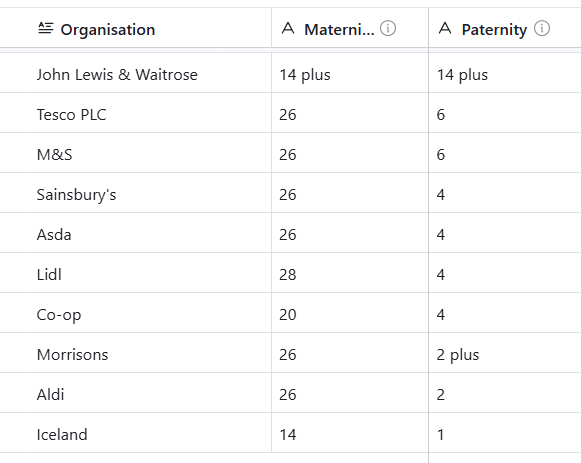
In other words: it can be done — if you choose to do it.
Stephanie Rogers, Chief People Officer at Lidl GB, framed it clearly:
“Our colleagues are the backbone of our business, and their success is our success… This also means supporting our teams during key life stages so we’re excited to announce our latest updates to our family leave policies, including a doubling of paid paternity leave.”
That’s not radical language. It’s practical leadership.
Why This Gap Still Matters
Large discrepancies between maternity and paternity leave shape behaviour, assumptions and careers.
When fathers are under-supported:
mothers remain the default parent
women absorb more unpaid labour at home
men are back to work before bonds are formed and stitches have healed.
gender pay gaps widen, not narrow
This isn’t just a social issue. It’s a workforce stability and performance issue, particularly in sectors with huge frontline populations and thin margins for attrition.
The Real Question for Employers
The question is no longer “can we afford to enhance paternity leave?”
The evidence shows many already do.
The real question is:
What kind of workforce, and what kind of families, are your policies shaping?
Benchmarking matters. Context matters. And direction of travel matters most of all.
If you want to understand how your organisation compares — not just on maternity, but on paternity and shared parental leave — the data is there.
The only remaining decision is whether you’re prepared to act on it.