
Beyond the Basics: Best Practice in Parental Transition Support
1) What is the parental transition and why does it matter?
The parental transition marks an individual's journey into parenthood. It spans the period from conception through the early years of a child's life - a time of significant physical, emotional, and lifestyle change.
This transition has real consequences for employers. It can directly affect employee productivity, engagement, and retention. New parents face sleep deprivation, increased caregiving responsibilities, and relationship strain. Without adequate support, balancing work and family life becomes harder, and turnover rises - particularly among mothers who may face what's known as the "Motherhood Penalty."
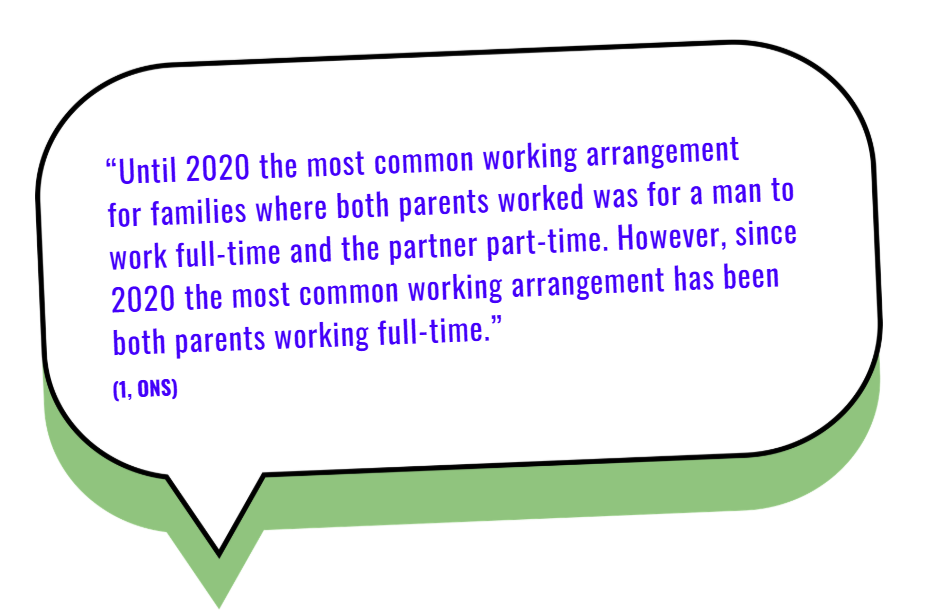
The context has also shifted dramatically compared to previous generations. Both the need and desire for both parents to work now dominates modern family life. According to the ONS, the most common working arrangement for couple families in the UK is both parents in employment, with 73.9% of households now in this position. (reference 1, ONS)
Despite this shift in earning dynamics, women continue to shoulder the majority of domestic responsibility. A 2022 BBC investigation found that 45% of female breadwinners still do most of the household tasks, compared to just 12.5% of male breadwinners. (2, BBC)
What is the Motherhood Penalty?
The Motherhood Penalty describes the professional disadvantages women face as a result of becoming mothers. It is a significant and well-documented phenomenon:
➡️ Up to 74,000 women every year lose their job for getting pregnant or taking maternity leave - a 37% increase from 54,000 in 2016. (3, Pregnant Then Screwed).
➡️ Research by Correll et al found that working mothers are disliked, less respected, disapproved of compared to non-working mothers, and less likely to be promoted regardless of qualification or performance. (4, Correll)
➡️ Childcare costs are routinely framed as a cost against a mother's income, rather than a shared household expense.
➡️ 75% of the gender pay gap is attributed to the motherhood penalty. (5, PWC)
What about fathers? The Fatherhood Forfeit
Gender stereotyping doesn't only affect women. Research shared by Dr Jasmine Kelland of the University of Plymouth shows that "good fathering" is still culturally linked to being a financial provider, and being largely absent from caregiving.
When men break these gender norms, they face what Dr Kelland calls
The Fatherhood Forfeit
- US studies found that fathers who are actively involved in caregiving, in ways that contradict gender norms, suffer negative professional consequences.
- Fathers are less likely than mothers to be offered roles that enable them to combine caregiving with work, such as part-time positions, because they score lower in selection processes. (6, University of Plymouth)
Voting with Their Feet
Poor parental leave doesn't just affect individual employees - it affects an organisation's ability to retain talent. Virgin Money's 2021 research (7) revealed that:
- 60% of working parents would consider leaving their company due to inadequate parental leave.
- 1 in 7 (14%) have already left a job because of dissatisfaction with parental leave.
- Almost a third (29%) feel that maternity and paternity leave in the UK is generally outdated.
2. What are the policy basics?
Before going beyond the basics, it's worth establishing what the foundations look like. The minimum that employers should have in place includes:
- Statutory maternity, paternity, and shared parental leave
- Supporting employees' legal right to request flexible working
- Upholding laws preventing discrimination
- Childcare assistance through salary sacrifice tax schemes
- Actively communicating support options to all employees
- An open line of communication with HR for policy queries
3. Options for moving beyond the basics
The statutory baseline is a starting point, not a destination. Employers looking to lead on parental transition support have a wide range of options available:
- Enhanced maternity leave
- Enhanced paternity leave
- Equal parental leave regardless of how you become a parent
- Parental leave covering adoption, surrogacy, baby loss, and neonatal stays
- Tracking parental leave uptake
- Parental coaching or peer buddy support
- A guide for line managers of new parents
- Training for line managers of new parents
- Phased return to work
- All roles open to default flexibility
- On-site or subsidised childcare
- Emergency childcare provision
- Parent networks (with budget and executive sponsorship)
- Sharing senior and peer role model stories
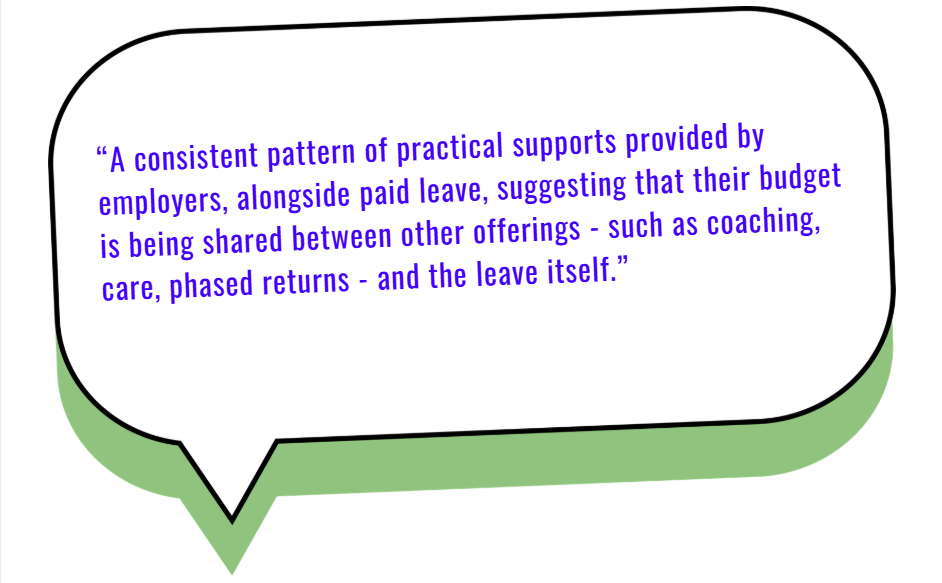
Bright Horizons' 2023 Parental Leave and Family Support Benchmark (8) identified a consistent pattern among leading employers: practical supports are offered alongside paid leave, suggesting budgets are being spread across coaching, care, phased returns, and the leave itself rather than leave alone.
4. A focus on enhancing parental leave
Enhanced parental leave is just one of the options above, but it can underpin all the others. It signals intent, creates the space for transition, and enables parents to make use of the other supports on offer.
**What the data shows:**
In 2023 Bright Horizons (8) surveyed over 500 UK organisations anonymously:
⭐ Over 60% of employers now provide enhanced pay above statutory - 72% for maternity and 64% for paternity.
⭐ 56% offer inclusive (equal) parental leave regardless of parenting role, with an average equal leave length of 14 weeks.
While the 2024 Working Families Benchmark (9), covering 69 firms, found:
⭐ On average, employers offered 18 weeks of fully paid maternity leave and 5 weeks of fully paid paternity leave.
⭐ Where an equal parental leave policy was in place, it averaged 21 weeks of fully paid leave as a day one right.
The Inspiring Dads Database
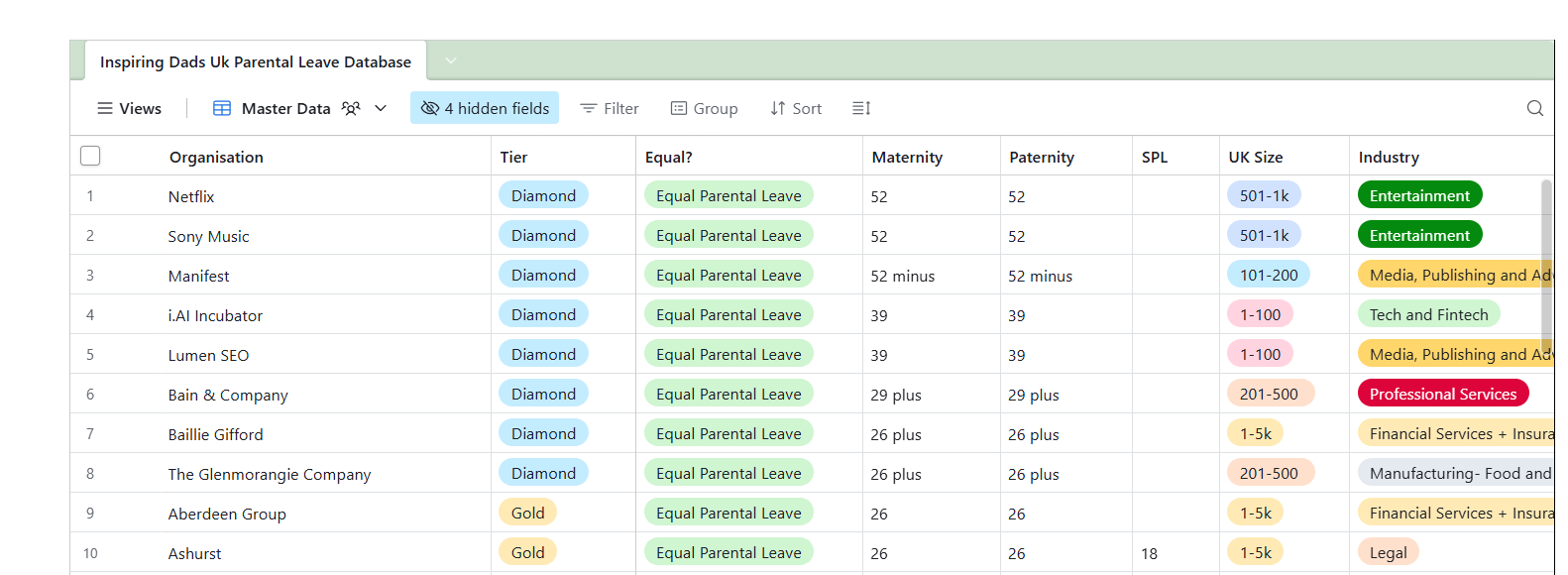
While Bright Horizons and Working Families benchmarks present aggregated summaries, at Inspiring Dads, we have developed a comprehensive database identifying hundreds of UK-based organisations and the detail of their parental leave policies.
Our UK Database shows:
👏 164 Equal Parental Leave offers - see our collaboration with Parenting Out Loud
👏 80 offer at least 26 weeks of fully paid, Equal Parental Leave.
👏 Plus, 114 “Equal via Shared Parental Leave” offers (where Maternity and SPL match)
👏 260 organisations in the UK who offer at least 6 weeks, fully paid Paternity Leave
(Correct on 12th April 2026, updated quarterly)
Organisations can be awarded one of 5 tiers.
Diamond. More than 26 weeks fully paid Equal Parental Leave (EPL).
Gold. 26 weeks fully paid Equal Parental Leave (EPL).
Silver. Between 18 & 25 weeks of fully paid Paternity Leave.
Bronze. Between 12 & 17 weeks of fully paid Paternity Leave OR 20 weeks plus of Shared Parental Leave.
Commended. Between 6 & 11 weeks of fully paid Paternity Leave OR 12 weeks plus of Shared Parental Leave.
Click here for free access : https://inspiringdads.co.uk/the-database
5.Creating a business case for enhanced paternity leave
Building a robust ROI for enhanced parental leave isn't always straightforward, but the case rests on four pillars:
Improved employee retention and recruitment - reduced turnover costs and stronger employer brand
Boosting productivity and engagement, supported employees return more motivated and committed
Supporting gender equality goals, equal leave drives cultural change and reduces the gender pay gap
Employer Brand signals, more powerfully than any careers page copy, what your organisation means when it talks about family, flexibility, and equality.
Read the full business case article for enhanced paternity leave at inspiringdads.co.uk/articles/enhanced-leave-business-case
References
4️⃣https://www.jstor.org/stable/10.1086/511799?seq=1
5️⃣https://www.pwc.co.uk/economic-services/WIWI/pwc-women-in-work-index-2023.pdf
7️⃣https://www.virginmoneyukplc.com/newsroom/article/all-with-new-colleague-package/
8️⃣https://solutions.brighthorizons.co.uk/blog/2023-parental-leave-and-family-support-benchmark
9️⃣https://workingfamilies.org.uk/publications/benchmark-report-2024/